

Marrakech rewards changes of scale. A busy square, the details of a courtyard, a garden and a museum photograph tell different stories about the city. The medina, recognised by UNESCO as a World Heritage property, forms the centre of this selection. Gardens such as Majorelle and the Menara also provide reasons to step beyond the busiest historic routes.
Allow three or four days for a first visit, depending on how much time you give each place. Group the medina visits and make separate plans for the gardens. Check current access arrangements before buying admission. Names appear in different transliterations, so save the precise location and entrance on your map rather than relying only on the spelling in a guide.
Before you pack
- Planning approach
- Group medina visits and make separate plans for outlying gardens
- Suggested pace
- Three or four days with breaks between monuments
- Before booking
- Check current access and reservation arrangements
1. Jemaa el-Fna: find your bearings in the square
Jemaa el-Fna is a useful starting point for understanding Marrakech. Official tourism information connects the square with life in the medina and describes an atmosphere that changes throughout the day. Instead of crossing it once on the way to a monument, consider returning at a different time to observe how vendors, visitors and meeting places alter its character.
Identify the route you used to arrive and the exit towards your next destination before exploring. If you want to eat or sit on a terrace, look at the menu and conditions before choosing. Ask permission to photograph people and agree beforehand on any service you request. The square is more rewarding when you can pay attention without treating every encounter as an obligation to buy.
2. Koutoubia: appreciate the minaret and its surroundings
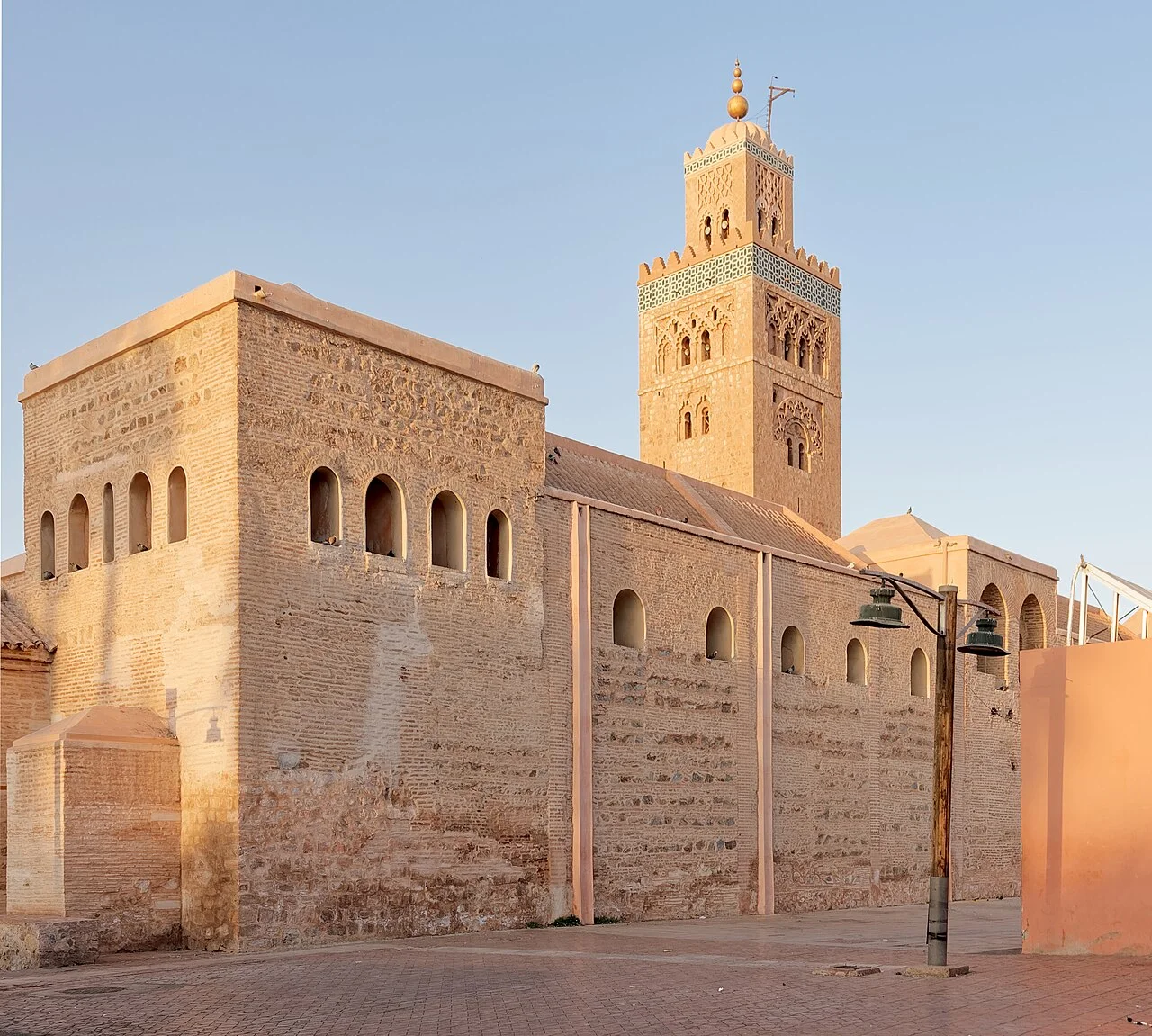
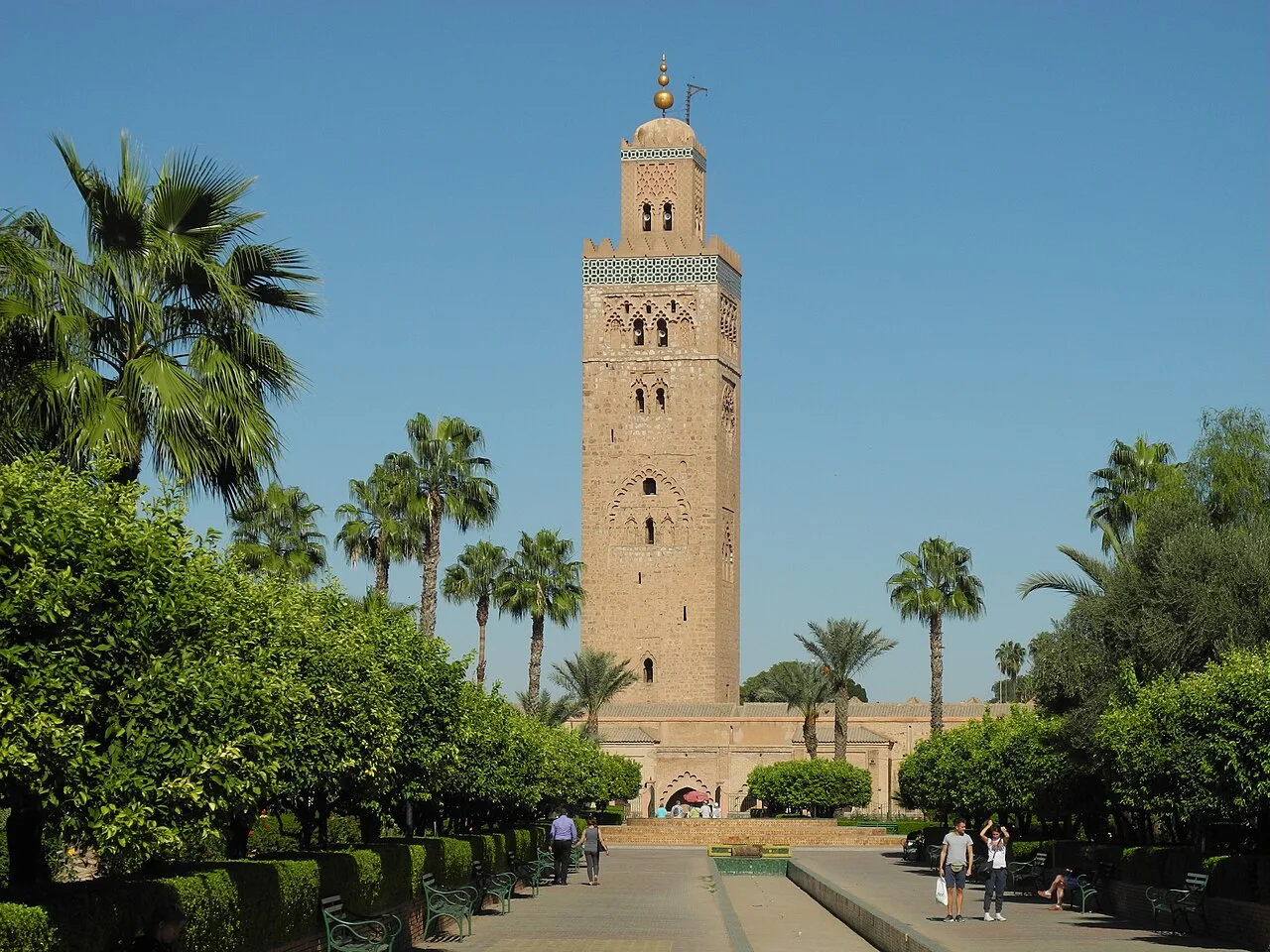
The Koutoubia provides a recognisable visual reference for exploring the city. An outdoor visit allows you to consider its minaret, building and gardens from different viewpoints. Official information makes an important distinction between these areas and the mosque interior: non-Muslims cannot enter. Plan accordingly, instead of approaching it as a museum whose entire interior is open to sightseers.
Allow time for a walk around the surroundings while respecting access instructions and prayer. You do not need to seek an interior entrance to appreciate the architecture. It can be combined with Jemaa el-Fna, but use a map to decide your actual route. A photograph never requires entering restricted areas or interrupting the religious activities for which the building exists.

3. Souk Semmarine: explore the market with curiosity
Souk Semmarine is one of the market areas highlighted by the regional tourism board, with textiles, carpets and craft objects. It is part of a network of lanes and businesses, rather than one shop or a closed exhibition. Comparing materials, finishes and the uses of objects gives the visit more substance than searching only for a predetermined collection of souvenirs.
Choose a recognisable entry point and save the location of any shop you may want to revisit. Ask about materials, provenance and transport arrangements before committing to a substantial purchase. If negotiating, remain respectful and confirm what the agreed price includes. Browsing without buying is also a legitimate way to explore; every walk through the souks does not need to become a shopping expedition.
4. Ben Youssef Madrasa: take time to examine the architecture
Ben Youssef is a former Quranic school recommended among the city’s cultural visits by the local tourism board. Including it introduces educational and religious architecture into a route through the medina. Look at how spaces are arranged and how decorative elements relate to one another, rather than reducing the building to the single photographic angle you may have seen online.
Check current admission arrangements and give the building a dedicated block of time. If hiring a guide, agree on the language, duration and scope of the explanation first. You can connect the visit with the Maison de la Photographie, checking the route on a map. Alternating observation with photography makes it easier to notice details that disappear when the whole experience is viewed through a screen.
5. Bahia Palace: a visit focused on architectural detail
Bahia Palace is another monumental attraction recommended by Marrakech’s regional tourism board. After the openness of squares and markets, a palace encourages closer examination of spatial organisation and decoration. Arrive with time to explore the areas that are actually accessible, remembering that visitor admission does not necessarily mean that every room or part of a complex is open.
Before entering, check the available route and any restrictions on photography or luggage. You do not need to know every architectural term to appreciate proportions, surfaces and transitions between spaces. If combining Bahia with El Badi, keep a break between them. Two different visits become less memorable when they are compressed into an uninterrupted succession of buildings with no time to reflect.
6. El Badi Palace: consider the scale of another palace complex
The ruins of El Badi reveal the scale of a palace complex from a different perspective than Bahia. UNESCO highlights them among the monuments expressing the medina’s heritage value. Here, understanding the arrangement of the site and what survives matters as much as decoration: begin by considering the whole complex before seeking individual details or a familiar photographic viewpoint.
Confirm the entrance location and what the ticket under consideration includes. If exhibitions or special routes are offered, check their arrangements separately; this guide does not assume they remain available all year. Allow time to observe the complex and read the interpretation provided. A shorter visit made with attention is preferable to collecting a list of spaces without understanding what you have seen.
7. Saadian Tombs: make room for funerary heritage
The Saadian Tombs bring funerary heritage into a selection otherwise dominated by palaces, gardens and commercial spaces. Both national and regional tourism information identify them as an important Marrakech attraction. Keeping that purpose in mind helps you approach the architecture as a place with historical and commemorative meaning, rather than simply another decorative setting within a sightseeing circuit.
Review current access arrangements and follow the route indicated at the site. Behave considerately and leave room for others to look without blocking circulation. Locate the palaces you wish to see on the same day so that journeys follow a coherent sequence. Proximity alone is not a reason to add every monument if doing so removes the time each place deserves.
8. Majorelle Garden: plants, colour and a clearly planned visit
Majorelle is one of the gardens highlighted in official visitor information for Marrakech. Its vegetation and colours offer a different pace after walking through the medina. Give it a dedicated visit: consider the arrangement of plants and spaces instead of seeking only the backgrounds that appear most frequently in photographs shared by other travellers.
Check the reservation system and the exact spaces included in your selected ticket. If you want to add a museum or associated activity, verify its specific conditions instead of assuming everything comes with the same admission. Plan the journey from your accommodation or the medina and avoid another inflexible reservation immediately afterwards. The time required depends on what you have actually chosen to visit.
9. The Menara: a garden organised around water
The Menara offers a different garden experience from Majorelle. The national tourist office highlights its extensive grounds and distinctive basin. Here the interest lies in the landscape as a whole and the relationship between vegetation, water and open space. It suits a visit that includes time outdoors without making shopping or a succession of exhibition rooms the main activity. UNESCO also identifies the pavilion beside the water as part of Marrakech’s heritage.
Treat the Menara as an outing in its own right and establish how you will arrive and return from your starting point. Bring water and suitable protection for the time you expect to spend outside, adjusting the visit to the day’s conditions. Avoid automatically attaching it to an already exhausting monument itinerary. A proper place in the schedule gives the garden room to be enjoyed.
10. Maison de la Photographie: discover Morocco through photographic archives
The Maison de la Photographie preserves and exhibits historical photographs relating to Morocco. Its stated purpose is to present the country’s diversity through these archives. After exploring streets and monuments, the museum offers another way to approach places and people: the images invite questions about how they were represented and which aspects of their lives were recorded.
The museum lists an address on rue Ahl Fes; save the precise location before walking through the medina. Check the current exhibition and allow time to read the texts accompanying the images. Photographs do not all represent the same period or place. Paying attention to their context prevents a historical scene from being treated as an automatic description of contemporary Morocco.
A route to get you started
- Day one: begin with Jemaa el-Fna and the exterior of the Koutoubia. Explore a manageable part of the souks without trying to cover every lane. Return to the square at another time if you want to compare its atmosphere, leaving space for a relaxed meal and for learning the medina’s layout.
- Day two: give Ben Youssef and the Maison de la Photographie a substantial block of time, checking their visiting arrangements first. Choose a palace for another part of the day if your pace allows. This is a way of grouping ideas, not a promise that every visit will fit into a fixed timetable.
- Days three and four: distribute Bahia, El Badi and the Saadian Tombs across the remaining time, and make independent plans for Majorelle and the Menara. With only three days, remove a visit before compressing each museum and garden into a hurried photographic stop. Let your interests determine what remains.
Good to know
How many days should I spend in Marrakech?
For this selection, three or four days provide an initial planning framework rather than an obligatory duration. Your pace, reservations and interest in museums or shopping will change the balance. With less time, choose contrasting places and avoid treating completion of the entire list as a requirement.
Can visitors enter the Koutoubia mosque?
The regional tourism board states that non-Muslims cannot enter the mosque. You can focus on the exterior and gardens while following local instructions. The opportunity to observe the building should not be confused with general tourist admission to its interior, and religious use takes priority over sightseeing.
Do all monuments and gardens share one ticket?
You should not assume so. Institutions have their own conditions, and associated spaces or activities may require separate reservations. Consult the relevant official channel and retain confirmation showing the exact attraction, date and included access before arranging the rest of the day around a booking.
Marrakech becomes more rewarding when squares, markets, historic buildings and gardens each have their own time. Use these ten places to choose what interests you, rather than as a checklist to complete at any pace. Returning to one setting and seeing it differently may add more to the trip than another visit made only out of obligation.
Sources consulted
- Marrakech - Marrakech - Vacations, travel tours, visits | Moroccan National Tourist Office —
- One Week in Marrakech | Visit Marrakech Morocco - BAHJA SPIRIT | Official Guide for Travel, Activities and Events —
- Marrakech Souks: A Captivating Stroll Through the Heart of the Most Exquisite Traditional Markets | Visit Marrakech Morocco - BAHJA SPIRIT | Official Guide for Travel, Activities and Events —
- Bienvenue à la Maison de la Photographie de Marrakech - Maison De La Photographie de Marrakech —
- Medina of Marrakesh - UNESCO World Heritage Centre —