

Buenos Aires works best when you alternate celebrated buildings, neighbourhood walks and breaks that do not require a reservation. These ten places bring together political history, music, art, books and nature. They do not form a single walking route: La Boca, Recoleta, the centre and Puerto Madero need planning by area so that transfers do not take over the day.
Distinguish looking at a building from booking an activity inside. Teatro Colón can anchor a particular part of your day, while a walk around Puerto Madero allows more flexibility. Use that difference to organise the trip and decide whether to spend longer in museums, explore neighbourhoods or combine both experiences. Ten places are a starting point rather than an obligation.
Before you pack
- Location
- Buenos Aires, Argentina
- Suggested pace
- Three or four days organised by neighbourhood
- Planning priority
- Book timed activities first, then arrange the surrounding walks
1. Plaza de Mayo and Casa Rosada: begin at the political centre
Plaza de Mayo introduces the political side of Buenos Aires. Casa Rosada, facing the square, is the seat of Argentina’s national government; its present façade joins earlier buildings through a central arch. Instead of taking one photograph and moving on, notice the relationship between the palace, the open square and the streets arriving from the city centre.
Use the square as a starting point for exploring the historic centre on foot. Looking at a public building from outside is different from joining an activity inside, so check current arrangements if you want to enter. Institutional access is not guaranteed simply by arriving at the door. For an initial introduction, exploring the surroundings helps you find your bearings without accumulating bookings.
2. Teatro Colón: choose between architecture and a performance
The present Teatro Colón opened in 1908 and forms part of the city’s architectural heritage. Its horseshoe-shaped auditorium, boxes and decorated dome reward attention even if you are unfamiliar with opera. The visit becomes more interesting when you consider how the room supports listening, rather than judging it only as an attractive interior to photograph.
Decide whether your priority is understanding the building or attending a performance. They are different experiences, and one ticket should not be assumed to include both. Check the theatre’s programme and visiting options. This area combines well with the Obelisk, allowing you to organise a central-city day around the reservation and leave the surrounding walk for before or afterwards.
3. The Obelisk and Corrientes: feel the centre’s urban rhythm
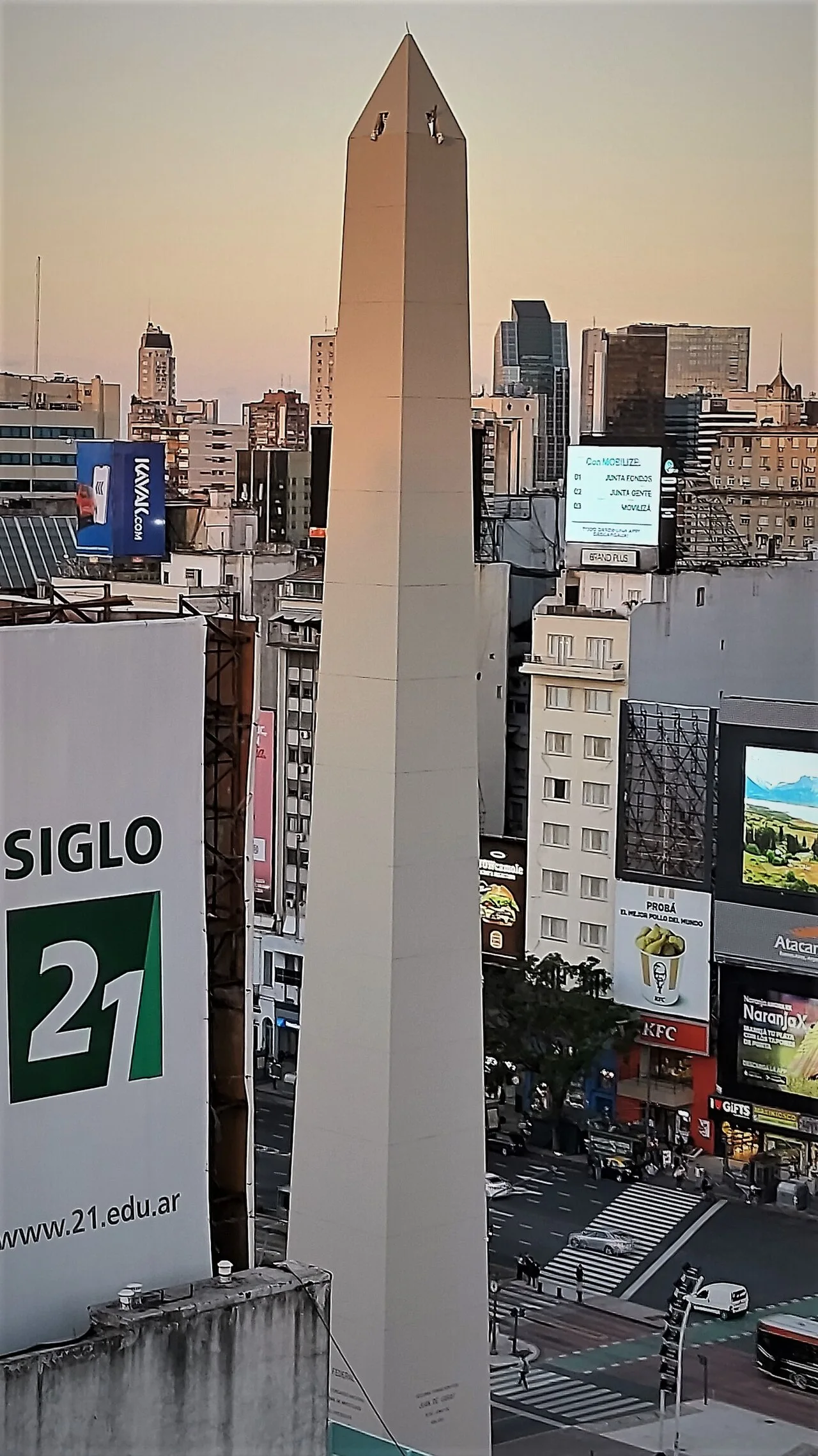
The Obelisk stands at the meeting of Corrientes and 9 de Julio avenues. Inaugurated in 1936, it was designed by Alberto Prebisch. More than an isolated landmark, it helps you understand a busy part of Buenos Aires: traffic, theatres and long urban views come together around its familiar silhouette.
Approach using designated pedestrian crossings and choose a viewing position without interrupting the movement of the avenue. Official tourism information now describes a viewpoint experience, but check its specific booking arrangements before planning an ascent. Seeing the monument from outside remains worthwhile in its own right. Afterwards, you can continue along Corrientes or combine the area with Teatro Colón.

4. Caminito: look beyond La Boca’s painted façades
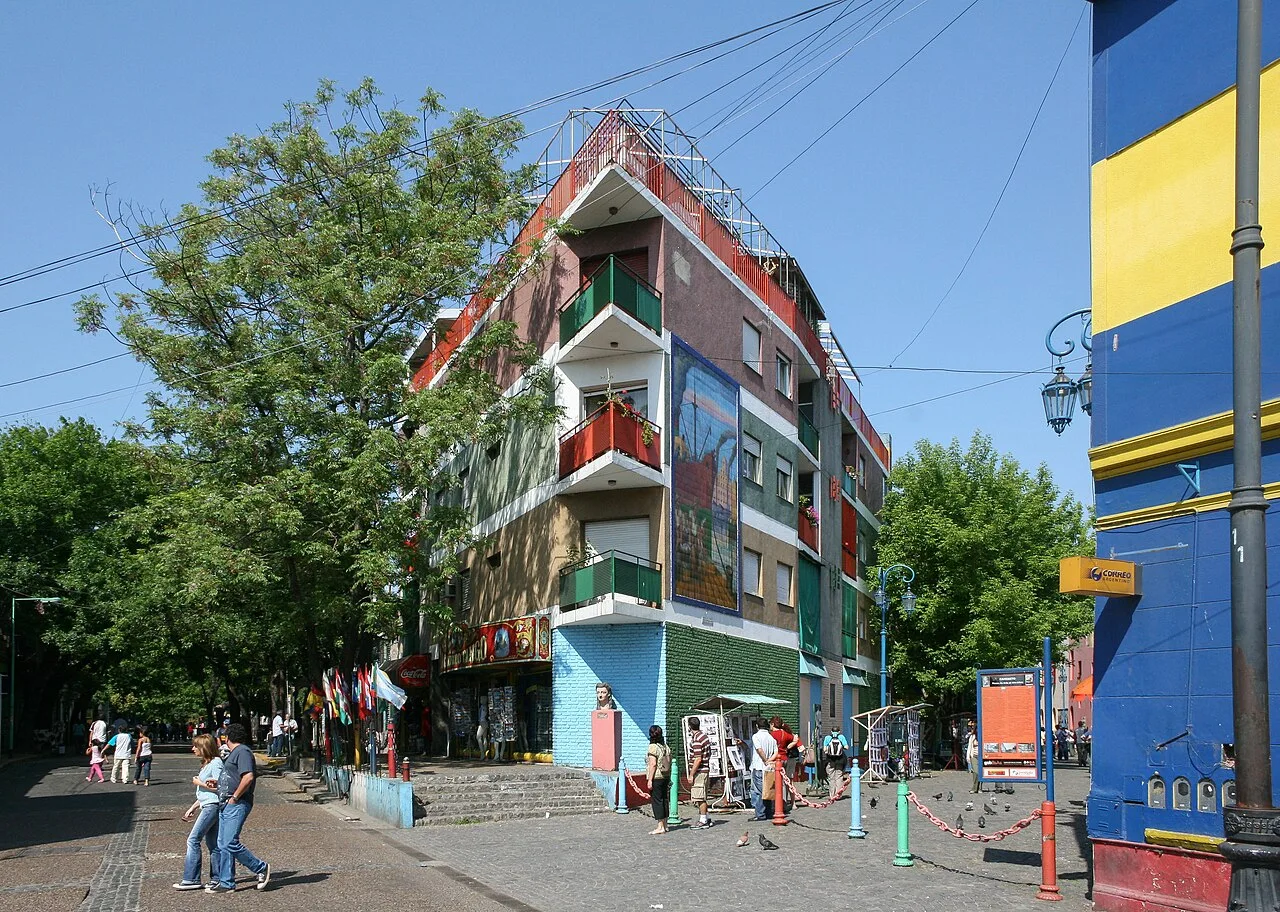
In La Boca, Caminito brings together painted metal façades, the memory of shared tenement housing and a history associated with Italian immigration. Artist Benito Quinquela Martín helped recover the area as an open-air museum street. Its colours catch your attention first, but understanding that background keeps the visit from becoming nothing more than a series of photograph backdrops.
Arrange your journey to and from Caminito rather than assuming it lies immediately beside the central sightseeing area. Explore the pedestrian space, notice the buildings and ask before photographing performances or entering a business. Distinguish public space from commercial experiences: a photograph, meal or show may come with its own conditions, which are best agreed beforehand.
5. Plaza Dorrego and San Telmo: antiques and neighbourhood life
Plaza Dorrego lies in the heart of San Telmo, surrounded by historic houses now used as cafés, restaurants and antique businesses. Defensa Street extends that atmosphere, inviting you to look at shop windows and façades. The official tourism office describes a Sunday fair, but the neighbourhood can also be explored on another day if you prefer an experience less centred on stalls.
Begin around Plaza Dorrego and choose a few nearby streets instead of trying to cover the whole district. If the fair is your main reason for coming, confirm that it is operating before the trip. When buying an antique, ask about provenance and any transport requirements. Taking home a small souvenir is different from purchasing an object that needs specialist packaging or documentation.
6. Recoleta Cemetery: architecture, memory and respect
Recoleta Cemetery reveals part of Argentina’s history through mausoleums, sculptures and familiar names. Opened in 1822, it preserves funerary ensembles of substantial architectural interest; Eva Perón’s grave is among its best-known sites. Approach it as a place of memory and respect as well as a cultural attraction, rather than treating its monuments simply as decorative scenery.
Check current entry arrangements before visiting. Once inside, choose a manageable route on the map and examine details on several tombs instead of reducing the outing to finding one famous grave. Keep passages clear and avoid leaning on delicate elements. The neighbourhood allows a combination with the National Museum of Fine Arts, provided you leave enough attention and time for each place.
7. Museo Nacional de Bellas Artes: make room for Argentine art
In Recoleta, the National Museum of Fine Arts brings together Argentine, Latin American and international art. Artists represented in its collection include Cándido López, Antonio Berni and Benito Quinquela Martín. On a first visit, giving attention to local work offers context that complements the streets and buildings you encounter elsewhere in Buenos Aires.
Check the institution’s current galleries and exhibitions, because owning a work does not mean it is permanently on display. Choose a group of rooms that matches your interests instead of trying to see everything at the same pace. The building has a story of its own: before becoming the museum, it was associated with the city’s water-supply system.
8. Puente de la Mujer: see Puerto Madero’s transformation
Puente de la Mujer crosses Dock 3 in Puerto Madero and was designed by Santiago Calatrava. The official interpretation connects its shape with a couple dancing tango. Beyond that image, the visit shows how water, former port areas and contemporary architecture create a landscape quite different from the historic centre.
Arrive at the dockside promenade and explore the pedestrian bridge between the Alicia Moreau de Justo side and Olga Cossettini, according to conditions at the time. Step out of the main flow to look at the structure. If you plan to continue towards the ecological reserve, check access and closing arrangements first: being near a green space does not guarantee you can still enter it.
9. Costanera Sur Ecological Reserve: change the scale of the day
Costanera Sur Ecological Reserve contains lagoons, grasslands, woodland and wetlands beside Puerto Madero. It provides an opportunity to exchange urban noise for observing plants and birds, without treating wildlife sightings as a guaranteed performance. The tourism office highlights walking routes and interpretive walkways that allow visitors to choose different ways of experiencing the area.
Check which entrances and circuits are open, then choose a distance that fits your energy and available time. Carry water and respect the protected area’s instructions; a path is not permission to approach every animal or leave the marked route. Combining the reserve with a dockside walk usually makes more sense than adding it at the end of an already overloaded sightseeing day.
10. El Ateneo Grand Splendid: explore a bookstore inside a theatre
El Ateneo Grand Splendid preserves elements of its former life as a theatre: the dome, boxes and stage remain part of the building’s appeal. The bookshop opened in 2000 and offers another approach to Buenos Aires’ cultural life. Look up at the architecture, but leave time to browse shelves and discover authors you may not already know.
Plan the journey to the bookstore as a stop in its own right, and check current conditions if an additional activity interests you. The tourism office distinguishes ordinary access from a separately ticketed special experience; do not assume every part operates under the same arrangements. Keep circulation clear for people buying and consulting books. This is a working bookshop, not only a photographic attraction.
A route to get you started
- A first day could combine Plaza de Mayo, the area around the Obelisk and Teatro Colón. Make any reserved performance or tour the anchor of the plan and use the remaining time for a flexible exterior walk. There is no need to add a distant neighbourhood just to make the day feel complete.
- Spend another day around San Telmo and La Boca, arranging transport between the two areas. A third could combine Recoleta, the fine arts museum and El Ateneo according to your interests. Leave Puerto Madero and the ecological reserve for a period with enough visiting time; on a short trip, choose between that outing and a more extensive cultural visit.
Good to know
Can I see all ten places in one day?
You can look at several exteriors in a day, but we would not recommend trying to enjoy all ten places in depth in so little time. Choose two areas and one cultural priority. This list is a way to build your own trip, not a suggestion that success depends on the number of stops.
Do I need to visit San Telmo on a Sunday?
The fair described by the tourism office takes place on Sundays, but streets, façades and shops make the neighbourhood interesting at other times too. If the fair is your main reason for visiting, check its current operation. If you prefer a different walking rhythm, consider another day.
Where should I check tickets and admission?
Start with each attraction’s official links. Guided visits, performances, viewpoints and special experiences may need separate reservations. A historical description on a tourism page also does not guarantee that every service is operating on the day of your trip.
The strongest selection leaves time to notice the city. Combine a building that interests you, a neighbourhood walk and a cultural or green-space break, then add further places without losing that balance. Buenos Aires offers enough contrasts to reward another trip, so your first visit does not need to exhaust every possibility.
Sources consulted
- Turismo Buenos Aires — Casa Rosada —
- Turismo Buenos Aires — Teatro Colón —
- Turismo Buenos Aires — Obelisco —
- Turismo Buenos Aires — Calle Museo Caminito —
- Turismo Buenos Aires — Plaza Dorrego —
- Turismo Buenos Aires — Cementerio de la Recoleta —
- Turismo Buenos Aires — Museo Nacional de Bellas Artes —
- Turismo Buenos Aires — Puente de la Mujer —
- Turismo Buenos Aires — Reserva Ecológica Costanera Sur —
- Turismo Buenos Aires — El Ateneo Grand Splendid —